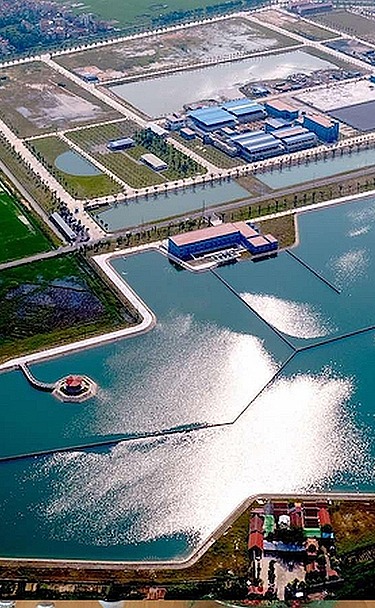

The Duong River Surface Water Treatment Plant is part of Hanoi’s vision to provide clean water for all residents by 2030.
Location:
Hanoi / Vietnam
Build time:
10/2018 – 10/2019
Client:
Aone Deutschland AG / Duong River Surface Water Plant JSC
Duong River Surface Water Treatment Plant - Phase 1B
The Duong river surface water treatment plant is part of Hanoi’s vision to provide clean water for all residents by 2030.
The phase 1B of the of the plant is part of a water treatment complex, which is designed for a final capacity of 900,000 m3/day in total. The treatment capacity of the Phase 1B of the Duong river surface water treatment plant is designed for 200,000 m3/day and started commercial operation in 2019. The Duong river surface water treatment plant is designed to provide clean drinking water by processing surface water from the Duong river applying conventional treatment process [raw water pumping and transfer / coagulation / flocculation / sedimentation / multi-media filtration / disinfection] including sludge treatment facilities.
Main sections of the plant:
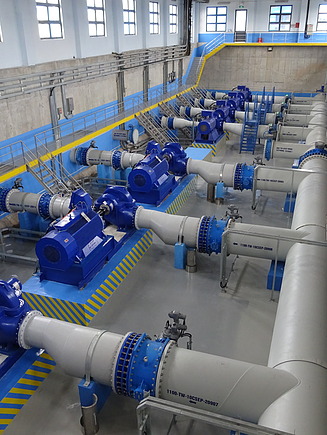
- Raw water intake & raw water pumping station
- Raw water transmission
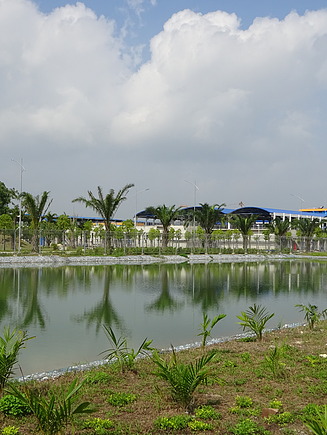
- Pre-sedimentation pond & settled water lift pumping station
- The efficiency of a water treatment plant, comprises:
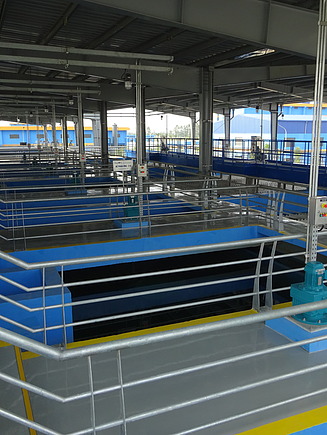
Depends on a synchronized industrial sequence designed to turn raw intake into safe, potable water. The process begins at the receiving chamber, which serves to dissipate energy and stabilize flow before the water enters the flash mixing tanks. In these tanks, a precision chemical dosing system introduces coagulants for rapid dispersion. The water then moves into flocculation tanks, where gentle agitation encourages the formation of settleable particles.
These particles are effectively removed in the sedimentation tanks. The resulting solids are collected in the clarifier sludge sump and transported via a dedicated sludge pumping station toward gravity sludge thickeners. To manage waste efficiently, the thickened residuals are moved by thickened sludge pumping stations to either sludge drying beds or an optional mechanical sludge dewatering system for final volume reduction and disposal.
Filtration, disinfection, and distribution
Following sedimentation, the clarified water passes through dual media filters to strain out microscopic impurities and fine suspended solids. To ensure the water is biologically safe for public consumption, a robust chlorination system disinfects the supply within the chlorine contact tank. Once purified, the finished product is stored in the treated water reservoir before being distributed to the municipal network by the treated water pump house.
Sustainability is maintained through a back-wash water tank and back-wash water pumping station, which perform routine filter cleaning. To minimize environmental impact and water loss, a back-wash water recovery tank and pumping station recycle this water back into the treatment loop.
Plant infrastructure and quality control
The entire facility relies on specialized electrical substations that serve the raw water intake, settled water intake, and the main plant. Operational oversight is centralized in the Administration building, which houses the SCADA room for real-time digital process monitoring and a state-of-the-art laboratory room for continuous water quality validation and safety compliance.
-
 © AQUAONE Corporation
 -
 © AQUAONE Corporation
 -
 © AQUAONE Corporation