Aerial view of a wastewater treatment facility featuring two circular clarifiers and long greenhouse-like structures used for solar sludge drying, surrounded by roads, grass areas, and nearby residential and industrial buildings.
Aerial view of a wastewater treatment facility featuring two circular clarifiers and long greenhouse-like structures used for solar sludge drying, surrounded by roads, grass areas, and nearby residential and industrial buildings. © Jakub Sadílek / STRABAG

Retrofitting of the sludge outlet at the Cheb wastewater treatment plant 

Location: 
Cheb / Czech republic

Build time: 
05/2024 – 03/2025

Client: 
CHEVAK Cheb a.s.

Back to Projects

Solar sludge drying

Retrofitting of the sludge outlet at the Cheb wastewater treatment plant 

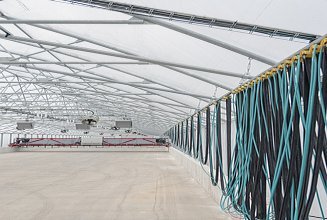
The solar dryer consists of two lightweight halls equipped with a mechanism for loosening, turning, and moving sludge during drying. The halls are designed as ventilated greenhouses heated by solar energy. Saturated vapors are removed by longitudinal ventilation flaps installed in the ridge of the hall, while fresh air is drawn in through double-sided longitudinal slits along the length of the hall. The hall is covered with a special double-layer blown film. Solar energy (greenhouse effect) is mainly used for drying. In the event of excess heat from sludge management operations, a heating system using hot water units (4 per hall) with a total maximum output of 220 kW can be used to intensify drying. The system includes an intermediate storage facility for dewatered sludge, which serves as an operational depot for imported sludge or sludge from dewatering. Dewatered sludge is transported to the solar halls by a wheel loader. In the future, the dried sludge will be used as a renewable energy source.

The contract was awarded in the form of Design&Build.

The basic parameters of the construction are:

  • Dimensions of the solar hall (2 in total)
  • Floor plan dimensions of usable area 125 x 12 m
  • Usable area of the hall (drying area) 2 x 1,500 m²
  • Dewatered sludge fed into the halls 3,465 t/year
  • Average initial dry matter content 20.6%
  • Amount of dried sludge 1,189.7 t/year
  • Amount of water evaporated by solar energy 2,275.4 t/year
  • Estimated average evaporation in the location 817 kg/m²/year
  • Dry matter in dried sludge (annual average) 60%
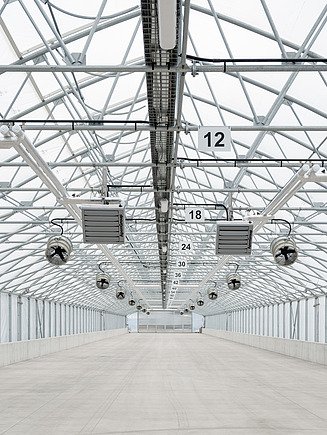
  • Interior view of a large greenhouse-like structure with a transparent roof and metal framework, designed for solar sludge drying, featuring an empty concrete floor and overhead ventilation fans.
    © Jakub Sadílek / STRABAG
  • Construction site at a wastewater treatment facility showing workers and heavy machinery installing large concrete slabs for solar sludge drying units, with trucks and equipment in the background.
    © Jakub Sadílek / STRABAG
  • Construction phase of a solar sludge drying facility showing a large open concrete base with a partially assembled steel frame structure under a clear blue sky.
    © Jakub Sadílek / STRABAG
  • Interior view of a solar sludge drying hall showing a large covered drying area with an automated sludge turning and conveying machine. The lightweight greenhouse structure is equipped with ventilation systems and sidewall openings to support solar-powered sludge drying.
    © Martin Červeňanský / STRABAG
  • Longitudinal view inside a solar sludge drying hall featuring a ventilated greenhouse structure, roof-mounted ventilation equipment, circulation fans, and heating units. The hall provides controlled conditions for the solar drying of dewatered sewage sludge prior to its use as a renewable energy source.
    © Martin Červeňanský / STRABAG
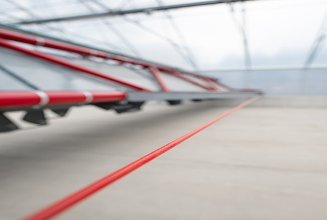
  • Close-up view of the automated sludge turning and conveying system inside a solar sludge drying hall. The red mechanical unit is used to loosen, turn, and transport sludge during the drying process, improving drying efficiency through regular material movement.
    © Martin Červeňanský / STRABAG
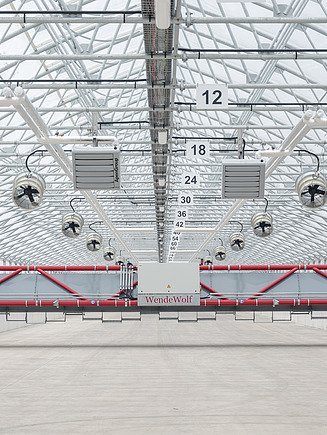
  • Front view of an automated sludge turning and conveying bridge inside a solar sludge drying hall. The equipment spans the full width of the hall and is used to loosen, turn, and transport sewage sludge during drying. Ventilation fans and heating units installed throughout the greenhouse structure support the solar drying process and optimize moisture removal.
    © Martin Červeňanský / STRABAG