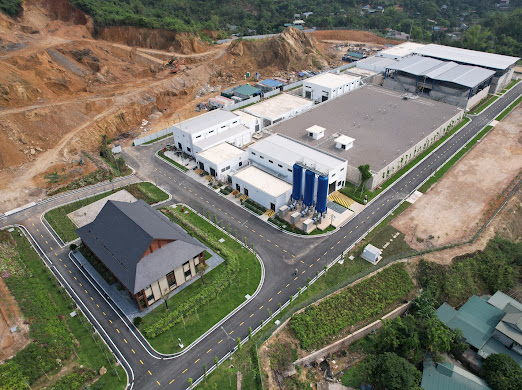
Engineering, Procurement, Installation and Commissioning of the Xuan Mai Surface Water Treatment Plant - Phase 1A with nominal capacity of 150,000 m3/d.
Location:
Hoa Binh / Vietnam
Build time:
01/2025 - 06/2026
Client:
AOne Deutschland AG / Hoa Binh – Xuan Mai Clean Water LLC
Xuan Mai Surface Water Treatment Plant
Engineering, Procurement, Installation and Commissioning of the Xuan Mai Surface Water Treatment Plant - Phase 1A with nominal capacity of 150,000 m3/d.
The newly completed Phase 1A of the water treatment plant strengthens the region’s water supply infrastructure. Equipped with state-of-the-art treatment technology, the facility has a nominal design capacity of 150,000 m³/day and has been engineered to allow for future expansion to 300,000 m³/day.
Scope of Works:
- Design: detailed engineering for Phase 1A and general layout for future extension
- Procurement & logistics of M&E equipment for Phase 1A
- Supervision of installation works
- Supervision of commissioning and start-up of the plant
Raw Water Intake and Pumping Station:
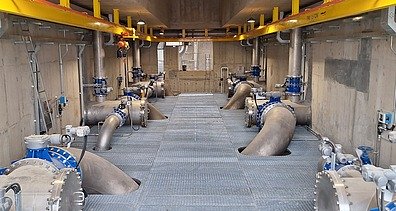
Civil structures of the intake and pumping station building are designed for the final nominal plant capacity of 300,000 m3/d and, as part of Phase 1A, 2+1 vertical turbine pumps, each with a capacity of 3,900 m3/h deliver water to the treatment process.
Coagulation / Flocculation System:
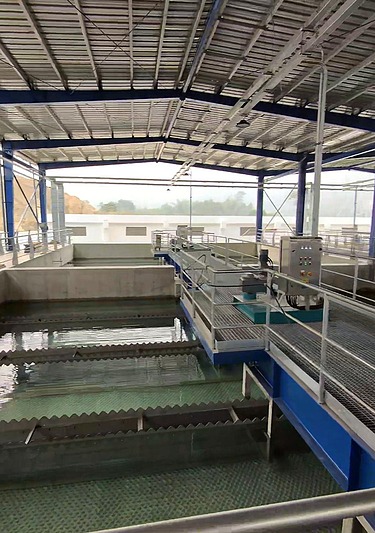
From the receiving chamber, water is distributed to two parallel flash mixing tanks where a coagulant agent is dosed and mixed for the coagulation process to take place. Through coagulation, the electrical charges that keep fine particles suspended are neutralized. Subsequently, water flows to 4 parallel flocculation tanks where a flocculant agent is dosed, and slow agitation promotes collision of the destabilized particles to build flocs large and dense enough to settle.
Sedimentation System:
Four parallel sedimentation tanks equipped with honeycomb lamella tubes and centrally driven sludge scrapers provide efficient settling while keeping the plant footprint compact. A part of the sludge produced is recirculated to the flocculation tanks, enhancing the flocculation process, while the excess sludge is further treated in subsequent steps.
Filtration System:
6 parallel dual-media (sand/anthracite) filters perform final filtration of remaining suspended solids from the clarified water. The filters' backwash system is designed to allow undisturbed continuous operation of the treatment process. Used backwash water is recirculated back to the receiving chamber, reducing water losses to a minimum.
Final disinfection, Storage and Distribution:
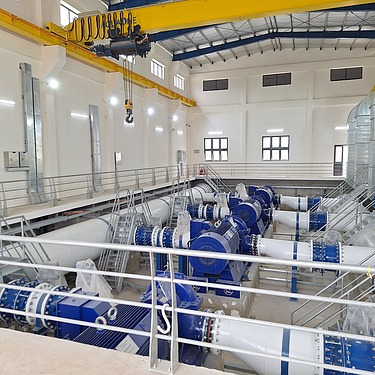
The filtered water is finally disinfected and flows into 2 parallel treated water tanks. A pumping station with 3+1 axially split casing double suction pumps, each with a capacity of 2,800 m3/h, delivers the treated and disinfected water to 2 intermediate reservoirs from which distribution into the network begins.
-
-
-